Though one could argue that this kind of innovation in derivatives may be what led to the credit crunch in the first place :)
9 years ago
Could this result in more wide sweeping changes to the way VAT is treated; perhaps similar to the recent developments in Norway for domestically traded emission allowances?
A very interesting analysis of an FT article written recently about Gazprom’s apparent drop from the “untouchable” status they’ve held in Russia as well as some of their gas woes.
Eco-Energy – one of the biggest mid-stream bio-fuel companies in North America – has recently chosen SolArc’s RightAngle product to support their growing business.
Article: Eco-Energy Selects SolArc RightAngle to Support Alternative Energy Supply Chain
OpenLink has scored first place in 11 different categories – including best ETRM package – in this years Energy Risk awards. For a summary article see:
OpenLink Sweeps the Boards in Energy Risk Survey 2010 | bobsguide, 16 March 2010
An interesting article in Scientific American about how competing interests in the North American power market are contributing to a variety of legislation to curtail wind power:
Will Politics Slow the Wind? | Scientific American, March 2010
There have been a number of press releases in recent days with regards to ETRM/CTRM product vendors:
A recent article from the NY Times explores the growing risk of corruption and fraud in the highly subsidized but lightly regulated wind business:
NY Times | With Wind Energy, Opportunity for Corruption

I was reading another POV on peak oil and found this graph in the discussion which I thought was well presented. You can find the article – which feels like a relatively even handed “peakist” view – here: Time and the Latest CERA Report. The actual article where this chart originated is more specifically geared to the relationship oil price has with recessions and can be found here: Further Evidence of the Influence of Energy on the US Economy. In this latter article, take a look at the comments from some not so moderate “peakists.”
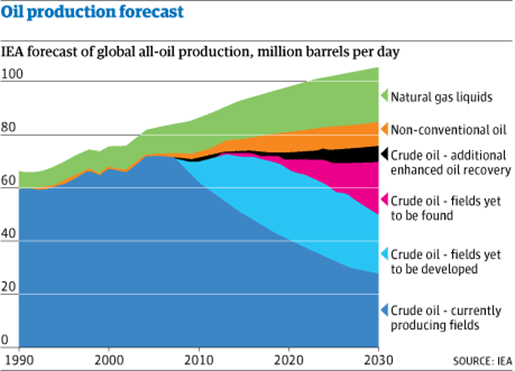
As we approach the release of the annual World Energy Outlook (released today) report from the IEA there are new reports coming out that suggest that the US Government has been putting pressure on the IEA to inflate the rate of flow through the supply chain from today’s 83m barrels/day to 105m by 2030. This new criticism has not been responded to yet by the IEA but apparently they have said they will respond to it soon.
Article Reference: Key Oil Figures Were Distorted by US Pressure | Guardian
How should we respond to this type of information? My suggestion is that we don’t react yet; this “finding” is really just in the rumour stage and unless the story develops we will likely be at the whim of two large “global storylines” promoted by very well capitalised interest groups or highly passionate people who both believe that the ends justify the means when it comes to mass media manipulation (or at least obfuscation). As a result these stories hit the press relatively frequently and the press – either unwittingly or through influence – promotes the stories as news more than as rumour. This in turn further entrenches most people into the camp that they were already in (a la, “the echo chamber” effect) and on occasion – typically when prices are directly effecting the end customer’s lifestyle – helps to create movement of public opinion in the debate. To be completely clear … I am not suggesting that this most recent rumour is incorrect, simply that there is no way to know at this stage.
Article: Great Energy Swindle | The Independent
Unfortunately the 'big six' supply companies may have some defence in their argument. It is quite likely that most of them do hedge forward their demand estimates as much as three years in advance; if they didn't their risk would really be too high and this would severely knock their share price. Ok, they will not have hedged their full volume in the first part of 2008, when prices were soaring, however, a large portion of their demand would have been covered at higher prices than we are seeing now.
This leads to many questions with two of the more interesting ones being:
- who did benefit from the higher prices locked in by the big six supply companies?
- When will we see some drop in prices on the back of recent lower wholesale markets?
The answer to the first question may depend on who the supply companies acquired their hedge from, which is probably a mix of their own internal trading company or the commodity trading banks, who by the way are all having massive years! A point to realise is that the integrated utilities do not really care about the electricity price but more about the generation margin (i.e. the difference between power and the fuel price - the so called 'spark spread' or 'dark spread'), which will not have seen such big gains because fuel prices were also high. This being said, we might expect the nuclear generators to be the big winners for once as their fuel price is less impacted by emission prices or other highly volatile energy markets.
The second question is harder and really depends on the hedging strategy in each company but certainly the retail prices ought to start looking lower from now. However, we should not expect the benefit to be a big hit though as the impact will be spread over the price we pay during the next three years or so.
Of course, if prices in the wholesale market start firming again then this benefit will be diluted; with commodity price induced inflation not far around the corner, because the supply/demand situation hasn't improved much of late, do not hold your breath!