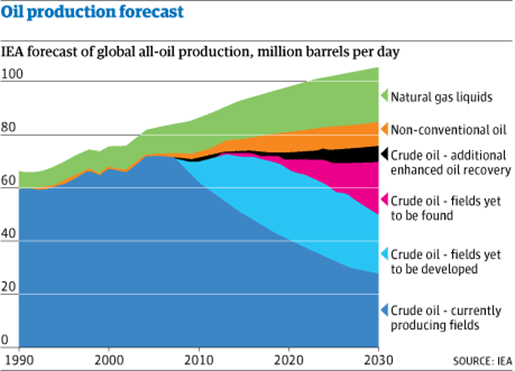
Recently Tony Hayward – BP’s CEO – was interviewed for an article in the UK’s Times newspaper where he claimed that Peak Oil was not a concern due to decreasing oil demand. You can refer to the original article here:
TIMES Online | BP's Tony Hayward warns of dwindling demand for oil
Here’s why I think Tony Hayward is wrong:
- The Economy. Energy demand (and oil demand) are highly sensitive to the economic climate and this being a global recession it is natural that energy use would go down . Also, current events and dipping world demand is not unique to 2008/9 and it is a short term effect. If anything, it is remarkable that demand only decreased by 1.6% when every country in the world is reeling from the current economic gloom. For instance, it is expected that the US economy will shrink this year by at least 3%. Most European countries will be similarly hit.
- The World. The last time the economy slowed down in a significant way the “emerging markets” were called “the third world” if you catch my drift. Not only will the Western economies come back the rest of the world is ready to consume significantly more per capita than ever before.
- The Efficiency Myth. While it may seem a misnomer at first, energy efficiency leads to greater consumption not less! If you want to consult history for some indication just look at the 20th century ... all forms of major energy use (aka, transport, heating, industrial, etc.) are MUCH MUCH more efficient than in the past and yet the demand curve is completely inverted. Why? Efficiency leads to lower energy costs (at least typically) and that combined with technological innovation lead to more and more ways to use energy. It is true that efficiency programs can have a short term effect on demand but even then they are often given too much credit as they are typically in fashion when the economy is in the proverbial toilet. Look at the 1970’s ... the whole “negawatts” movement spurred lots of positive movement toward energy efficiency (double glazed windows, maximum speed limits, incentives to insulate homes, etc.) but the downturn in demand was a flash in the pan.
Why would Tony say this?
- BP is an “oil company”. For almost all of BP’s storied history BP stood for “British Petroleum” and then for a brief moment they decided to change it to “Beyond Petroleum” which was a sneaky way of saying “we provide energy in any form”, “we’re greener than you think”, and “don’t hate us”. Tony Hayward was the person who made it clear that BP now stands for “Back to Petroleum”. In any event, the point is Oil companies are in the business of selling oil to the exclusion of very little else. Conspiracy theories aside, having marketing messages that help you make more money are not unusual in business and Tony is just doing what any CEO would do ... looking for messages that help his business prosper.
- Kill the Alternative. BP is ok with gradual investments into alternative/sustainable forms of energy and even participates in these markets but as an Oil company it benefits from doubts surrounding the potential of alternatives. The message about reducing demand is not a direct assault on alternatives but indirectly it weakens the economic argument for alternatives and takes some urgency away from switching away from fossil fuels (although the ecological/environmental urgency remains intact).
- Don’t Panic. Volatility is bad for most companies (trading companies excluded if they’re any good) and Peak Oil has the potential to create massive volatility through panic buying. Obviously panic would drive up the prices of oil (at least in spurts) which might seem like a not entirely bad thing for an oil company. However, the problem is the damaging impact it would have on the economy (and consequently consumption), and as history and current events have shown, the economy suffers much more through severe price volatility than it does when oil prices are high (look at Japan or even EU versus US as case studies on how sustained high energy prices can be absorbed into a healthy economy).
The one thing I think may be interesting over the next 5-10 years is the electrification of personal transport and heating (via heat pump technology). Especially the former could have a significant impact on the refined products market and I have no idea what that would look like but I’m sure it’s something that oil companies and refiners would rather not find out about. If there truly is a wholesale shift toward electrical transport and heating then potentially Tony will be right about oil demand (although it says a lot less about overall energy demand) however his rationale for demand destruction makes no sense to me.
This is just my opinion, happy to hear others’.