Correlating Recessions and Oil Prices

GDP and Oil Price over time

I was reading another POV on peak oil and found this graph in the discussion which I thought was well presented. You can find the article – which feels like a relatively even handed “peakist” view – here: Time and the Latest CERA Report. The actual article where this chart originated is more specifically geared to the relationship oil price has with recessions and can be found here: Further Evidence of the Influence of Energy on the US Economy. In this latter article, take a look at the comments from some not so moderate “peakists.”

World Energy Outlook released … concerns over it’s legitimacy raised

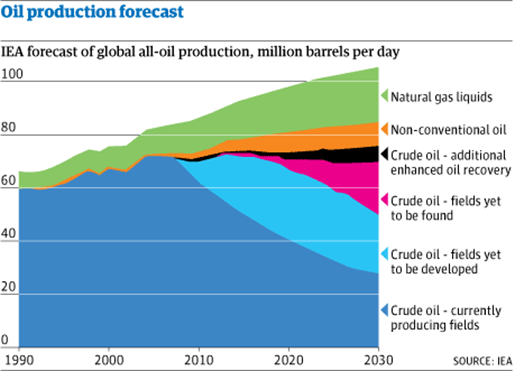
IEA's WEO for 2009

As we approach the release of the annual World Energy Outlook (released today) report from the IEA there are new reports coming out that suggest that the US Government has been putting pressure on the IEA to inflate the rate of flow through the supply chain from today’s 83m barrels/day to 105m by 2030. This new criticism has not been responded to yet by the IEA but apparently they have said they will respond to it soon.

Article Reference: Key Oil Figures Were Distorted by US Pressure | Guardian

How should we respond to this type of information? My suggestion is that we don’t react yet; this “finding” is really just in the rumour stage and unless the story develops we will likely be at the whim of two large “global storylines” promoted by very well capitalised interest groups or highly passionate people who both believe that the ends justify the means when it comes to mass media manipulation (or at least obfuscation). As a result these stories hit the press relatively frequently and the press – either unwittingly or through influence – promotes the stories as news more than as rumour. This in turn further entrenches most people into the camp that they were already in (a la, “the echo chamber” effect) and on occasion – typically when prices are directly effecting the end customer’s lifestyle – helps to create movement of public opinion in the debate. To be completely clear … I am not suggesting that this most recent rumour is incorrect, simply that there is no way to know at this stage.

Why Smart Meters are not a silver bullet

A dose of real world analysis in the midst of the smart meter euphoria... this article talks about how utilities need to do more than just install smart meters for them to be an effective tool in reducing our energy usage...

Smart Meters: Not So Sharp For Consumers (from forbes.com)

MPs demand inquiry into great energy 'swindle'

Article: Great Energy Swindle | The Independent

Unfortunately the 'big six' supply companies may have some defence in their argument. It is quite likely that most of them do hedge forward their demand estimates as much as three years in advance; if they didn't their risk would really be too high and this would severely knock their share price. Ok, they will not have hedged their full volume in the first part of 2008, when prices were soaring, however, a large portion of their demand would have been covered at higher prices than we are seeing now.

This leads to many questions with two of the more interesting ones being:
- who did benefit from the higher prices locked in by the big six supply companies?
- When will we see some drop in prices on the back of recent lower wholesale markets?

The answer to the first question may depend on who the supply companies acquired their hedge from, which is probably a mix of their own internal trading company or the commodity trading banks, who by the way are all having massive years! A point to realise is that the integrated utilities do not really care about the electricity price but more about the generation margin (i.e. the difference between power and the fuel price - the so called 'spark spread' or 'dark spread'), which will not have seen such big gains because fuel prices were also high. This being said, we might expect the nuclear generators to be the big winners for once as their fuel price is less impacted by emission prices or other highly volatile energy markets.

The second question is harder and really depends on the hedging strategy in each company but certainly the retail prices ought to start looking lower from now. However, we should not expect the benefit to be a big hit though as the impact will be spread over the price we pay during the next three years or so.

Of course, if prices in the wholesale market start firming again then this benefit will be diluted; with commodity price induced inflation not far around the corner, because the supply/demand situation hasn't improved much of late, do not hold your breath!

BP’s new Chairman

Rumblings from up high in BP …

BP’s New Chairman to Lead Shakeup | Reuters

Wireless Power (nearly) a Reality

I am sure many readers of this blog have the daily annoyance of needing to carry around multiple charging adapters and plugs (Laptop, iPod, Mobile, GPS). The lack of standards across devices (no one charger to rule them all) and having to carry around long, self knotting wires make this an exercise in minor frustration.

Because of this I have been following the research and development effort on wireless device charging for some time now. There seems to be a few players out there with slightly differing technologies, but recently PowerMat has announced it is about to release a product which uses magnetic induction to distribute power. Key features include charging multiple devices simultaneously and the same or faster recharge speeds (not sure how that works?).

What's the catch? Well currently it seems to be aimed at small devices (phones but not laptops) and product support is, as is to be expected, limited. Currently there seems to be two options – product specific back panel receivers (which are slightly bulky) or a receiver with USB and other adapters. If popular, I hope product manufacturers will adopt.

I wonder if this is a ‘green’ solution or is always drawing power from the mains and distributing into the Ether.

Check it out.

Blame the speculators.. or is it currency movements. Why not just listen to the market?

If it is not the options traders causing higher oil prices then maybe OPEC are correct that the speculators are to blame, at least according to Abdullah al-Badri (the secretary-general of OPEC).


Speaking at the same conference, Tony Hayward (chief executive of BP) also said that the recent rise in oil prices was related to currency movements; are the currency traders to blame then?
http://business.timesonline.co.uk/tol/business/industry_sectors/natural_resources/article6882056.ece


So why is anyone to blame? My understanding is that prices go up because there are more buyers than sellers (economics 101). I just wonder why it isn't simply that the market thinks current prices are too low; somebody is clearly willing to take delivery of oil at these levels and so called speculators only buy because they believe prices are going up; oh and they also sell when they think prices are going down.


The only thing that we can be sure of is that nobody knows...isn't that why markets exist and why there is risk!